
In the Netherlands we use the so-called Chipknip electronic purse card. This is a local name for the system which is internationally known as the Proton purse system. It is typically used for small payments like parking lots, payphones and company restaurants. For instance the Dutch Chipknip has a maximum balance of 500 euro.
Before you can use your card to pay at a point-of-sale terminal, you have to charge it. Charging requires an online connection to the bank. And like with debit payments you have to provide the correct PIN. Once your card is charged, you can use it offline and without PIN to pay. All you have to do is confirm that the amount on the display will be charged to your balance on the card. Because these payments are offline they are much faster than debit payments. In particular the security system for these payments is based upon 'something you have'. The system for charging the cards is the same as for debit cards: 'something you have' and 'something you know'.
After a certain amount of time (typically each day) the sales terminal collects all the payments and asks the banks to transfer the corresponding amount of money. The back office taking care of this is very important. The banks keep track of all payments done with a card. The card also keeps track of the last five transactions it was involved in. Obviously, if a card is involved in a list of transactions of a sales terminal, the banks check their shadow bookkeeping to see if there are irregularities or not. If there are, the card will be blacklisted and becomes worthless.
In some cities in the Netherlands the Chipknip is the only way to pay for your parking lot. Because not everybody has a bank card with Chipknip functionality, one can buy a pre-paid card. The bad thing of these pre-paid cards is that have to pay a fee: you pay for instance 10 euro but the card you get is only charged with 7.5 euro. The good thing is that the card is anonymous. The aforementioned back office knows which card is being used for which transaction. But in case of a pre-paid card this cannot be linked to a person.
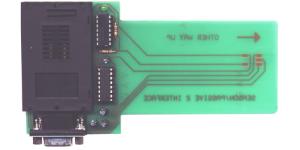
By eavesdropping on a Chipknip in action, for example using a device as shown in Fig. 1, one can hope to reverse engineer the protocol used by the Chipknip.
|
| Fig. 1: Interesting device |
It turns out that the Chipknip is based on the EN 1546 standard. The Chipknip system is fairly secure. As far as we know, the protocol or cryptography has not been broken, in the sense that the balance on Chipknips can be incremented without corresponding decrements of bank accounts. However, it is possible to let money disappear from the system, or to corrupt the log files on a Chipknip.
These log files are not protected. Anyone with a card reader and some knowledge on the communication protocol can build programs to read the information in these logs. Here you can see a screen shot of a card that has been used until March 2003 but is no longer valid.
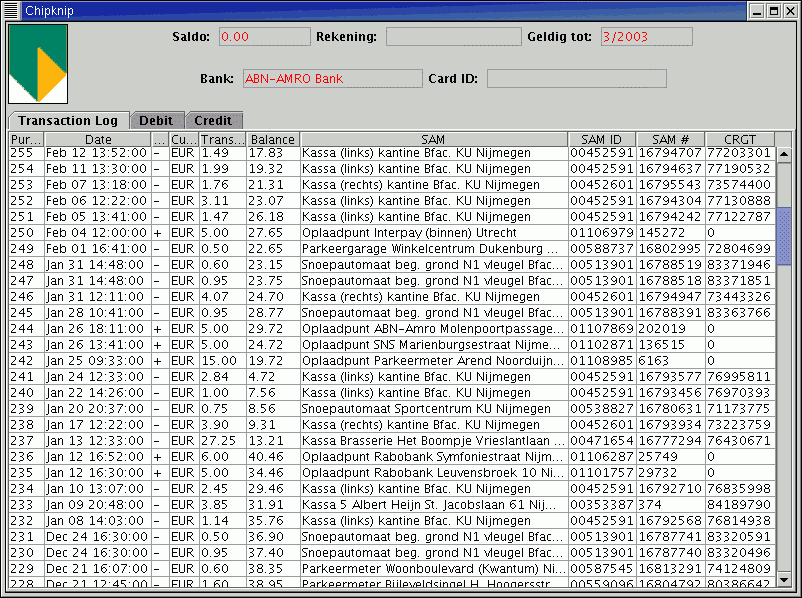 |
| Fig. 2: Chipknip transaction log checker |
The demo program shown in Fig. 2 is able to read information from an inserted Chipknip card. So what do we see here?
Note that our application not only uses a database for mapping the terminal IDs, but also to store the history of the card in order to overcome the problem that there are only five entries on the card itself.
People who worked on this: Engelbert Hubbers, Martijn Oostdijk.